


KEY INITIATIVES: TRAIL CONNECTIVITY
TRAIL CONNECTIVITY
Part of protecting and preserving land in the eastern Catskills involves working with state and local officials as well as community members to create points of access for residents and visitors to enjoy nature while protecting the surrounding environment. Shared-use trails are one of those points of access as they offer safe connections for pedestrians, runners, cyclists and differently abled individuals between different areas while also offering recreational opportunities.
What's a shared-use trail? Sometimes called a multi-use trail, a shared-use trail is a two-way, off-road facility that's physically separated from motor vehicle traffic by open space or a barrier. They are intentionally designed for both transportation and recreation. The American Association of State Highway and Transportation Officials (AASHTO) has national standards for these trails, ensuring they meet federal ADA requirements, promote safety for all users and protect the natural environment.
RAIL TRAILS
Opened in October 2019 to enthusiastic crowds, the Ashokan Rail Trail offers spectacular views of the scenic and forested north shorelands of the Ashokan Reservoir without fee or permit, for the first time in a century. The 11.5-mile rail trail was developed by Ulster County, with WLC’s support along with other stakeholders, through NYCDEP lands along the 38.6-mile former U&D rail corridor. WLC has inaugurated with NY/NJ Trails Conference a highly-successful volunteer stewardship program for the Ashokan Rail Trail. Three trailheads with parking are located along Route 28. More info at ashokanrailtrail.com
In addition to the now-opened ART, we also support the County’s efforts in expanding the Kingston Linear Park between Midtown and Uptown Kingston, and we continue to advocate for the ultimate vision of connecting the ART to a county-wide network of rail trails, from the Walkway-Over-the-Hudson north through Ulster County to Kingston and the Rondout Valley, to the Ashokan Reservoir and Catskill Park, and to the Empire State Trail.
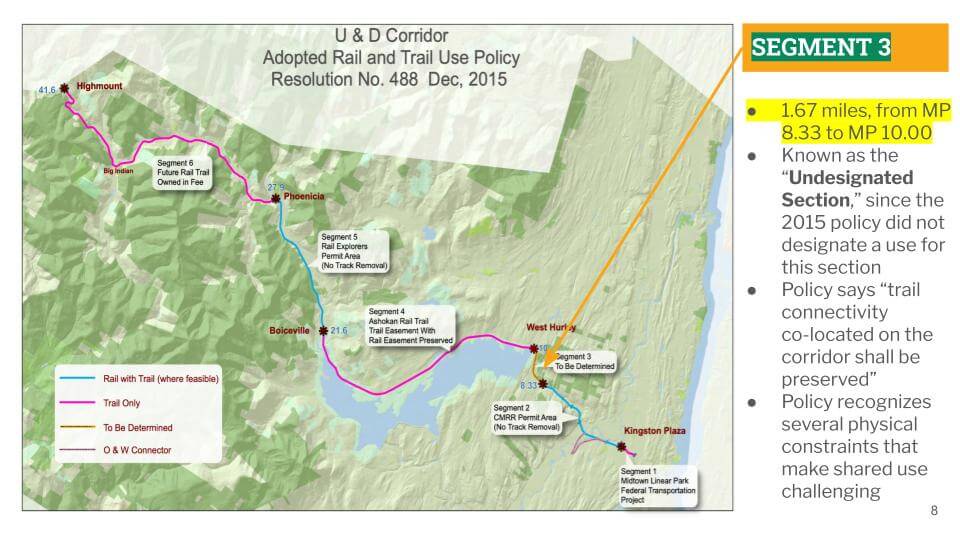
In 2024, the Ulster County legislature began exploring the only part of the U&D Corridor not yet designated for trail use. It is called the "undesignated section," and it is a vital link to the eventual connection of the ART to Kingston. WLC is the convening organization of a large coalition of community members advocating for trail connectivity between the Ashokan Rail Trail and Midtown Linear Park. If you'd like to learn more about this initiative, visit the Kingston Ashokan Trail website, KATrail.org.
MULTI-USE TRAILS
WLC also worked with Open Space Institute (OSI) and NYSDEC to develop a gently sloping, family-oriented multi-use trail on a 208-acre property that OSI conveyed to the state to link two previously unconnected sections of the Catskill Park’s Bluestone Wild Forest: Jockey Hill to the east and Onteora Lake to the west. The main trail runs through intact forests, the northern portion of a beautiful and high-quality body of water known as Pickerel Pond, and significant wetlands. The multi-use trail is open for hikers, mountain bikers, runners, walkers and offers more than 28 linear miles of trail. Conveniently located near several population centers including Kingston and Woodstock, the nearly 3,000-acre Bluestone Wild Forest is a popular outdoor recreation destination. Bluestone Wild Forest
ULSTER COUNTRY'S GREEN TOURISM
The protected property in the Bluestone Wild Forest figures into OSI’s and WLC’s efforts to help support Ulster County’s expanding green tourism economy, relieving pressure on wildly popular trailheads and important summits while also protecting and consolidating significant portions of the Catskill Park.
Tourism is a significant sector of our local and regional economy, and the growth of recreation, agrotourism and eco-tourism supports sustainable economic development. Creating, connecting and promoting trails in wild and scenic areas, especially when connected to a larger trails network, will support the growth of local businesses and help improve the health and quality of life for local residents, even as it builds appreciation of and support for conserving key lands and habitat. Trails that connect also offer non-motorized transportation alternatives, helping reduce greenhouse gas emissions and traffic congestion.